
Painted road markings are hard to see at night and almost disappear in heavy rain. Road studs, often called cat's eyes, fix that. These small raised markers reflect vehicle headlights back to the driver, so lane edges, medians and curves stay visible after dark. This guide covers how they work, the main types, and where to use them.
How reflective road studs work
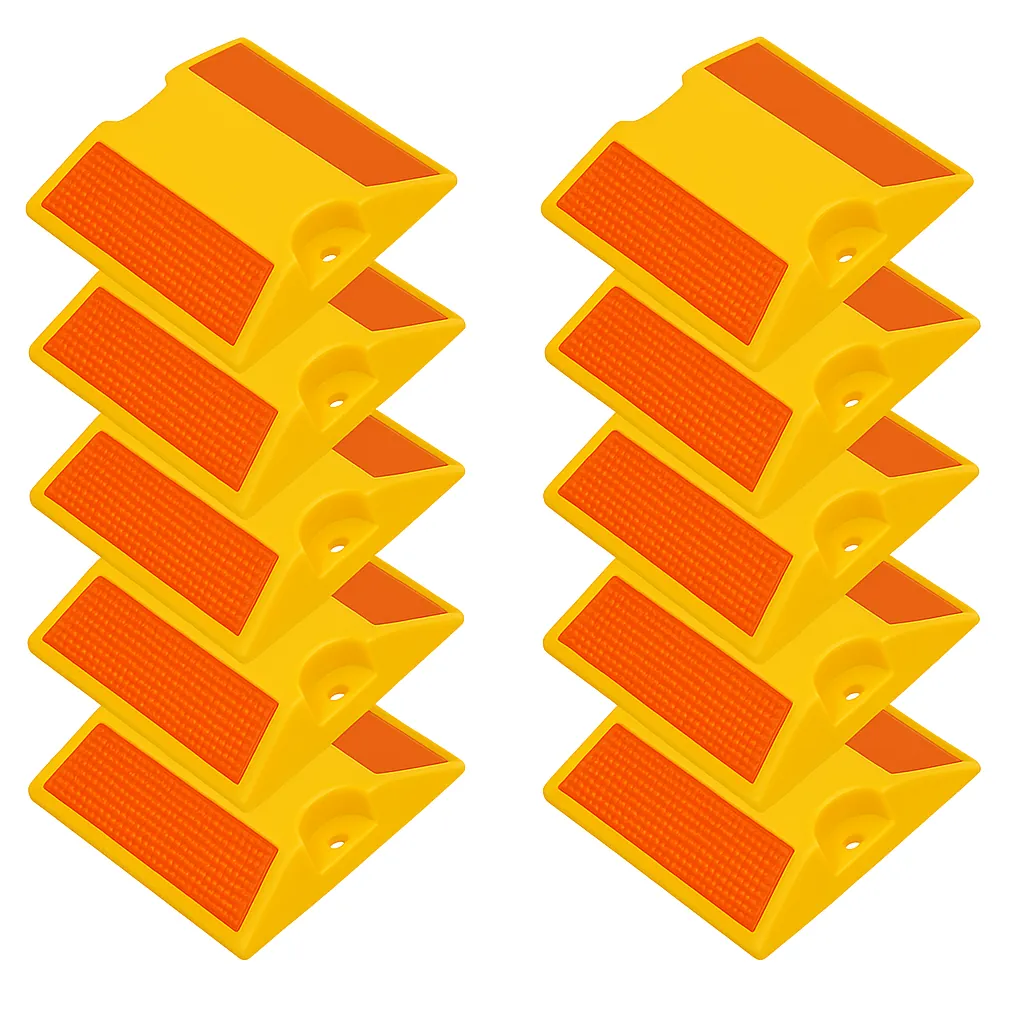
A road stud has a tough body fixed to the road surface and one or more reflective panels facing oncoming traffic. Headlight beams hit the panel and are reflected straight back toward the driver, so the stud appears to glow. Because the stud is raised above the surface, it stays visible even when rain covers flat paint lines, and drivers feel a slight vibration if they drift over it.
Common types of road studs
| Type | How it works | Typical use |
|---|---|---|
| Plastic (ABS) reflective studs | Moulded body with reflective panels | City roads, parking, junctions, medians |
| Aluminium-body studs | Cast metal body with reflectors | Highways with heavy traffic |
| Solar / LED studs | Built-in LEDs charged by sunlight | Dark stretches, sharp curves, bridges |
Kunplast's reflective road studs are ABS plastic, 10 × 10 × 8 cm and about 80 g, in bright yellow with reflective panels. They suit highways, city roads, parking lots and intersections.
Where to install road studs
- Lane lines and centre lines on undivided roads
- Road edges and medians, especially where there is no street lighting
- Curves and hill sections, where drivers need to see the road ahead
- Junctions, roundabouts and toll plazas
- Parking lots and driveways to guide cars at night
- Before speed breakers so drivers notice them in time (see our speed breaker guide)
Colours
Different colours are used to mean different things, for example to mark the centre line, the road edge or a median. On public roads, follow the colour scheme set by the road authority and Indian Roads Congress guidelines. On private premises, choose one scheme and use it consistently so drivers learn it quickly.
Installation basics
- Clean and dry the road surface at each marked position.
- Fix the stud with a suitable adhesive or anchor, according to the surface (asphalt or concrete).
- Face the reflective panel toward oncoming traffic.
- Keep traffic off until the adhesive has set.
Spacing is usually closer on curves and near hazards than on straight stretches.
Maintenance
Dirt and tyre rubber dull the reflectors over time. Inspect studs periodically, clean them where possible, and replace missing or broken ones so there are no gaps in the line.
Order road studs in bulk
Kunplast manufactures reflective road studs in Ahmedabad and supplies road contractors, municipal bodies, facility managers and dealers across India. Share quantities and delivery location for a quote.
Frequently asked questions
What is a road stud?
A road stud (cat's eye) is a small raised marker fixed to the road with reflective panels that return headlight beams, so lane lines and hazards are visible at night and in rain.
Where are road studs used?
On lane lines, road edges, medians, curves, junctions, toll plazas and in parking lots, wherever drivers need guidance after dark.
What size are Kunplast road studs?
10 × 10 × 8 cm, weighing about 80 g, made of ABS plastic in yellow with reflective panels.